Real Conversations

A real conversation, to me, has the excitement and uncertainty of a well moderated dispute. Any takers?

Posted in Agreements | Leave a comment

Melbourne Docklands Redesigns its Observation Wheel

Australia gets the largest observation wheel in the southern hemisphere.
This redesign is quite radical but really reflects what we consider is essentially Australia.

Posted in Agreements | Leave a comment

Tradition of Uncertainty

In the past tradition seemed to give us some degree of certainty. We knew when and who to marry and why; because everyone else was doing the same. Tradition meant safety in numbers and the majority ruled. Today, more than ever before, traditional norms are fading in importance but at the cost of losing the certainty that they brought.

Today, all we seem to have is more uncertainty. When should we marry or should we marry at all? Or if we are married should we stay together? And who should do the initiating now days, anyway? Who knows! Maybe the tradition of today is to embrace uncertainty and not try to dress it up as false or so-called certainty. Maybe uncertainty is the new black. At least the Tradition of Uncertainty and the certainty it brings us, is far more real than previous traditions and “certainty”.
But then again I could be wrong!

Posted in Agreements | Leave a comment

Complaints, Warnings & Feelings

What about this Steve, here is my latest definition of conversation and what it is for.

“Conversations are for converting our own reality into quality agreements,
using our past complaints, future warnings, and present feelings. “

So my question would be to you, when you said “what for”, was this a complaint about the past, a warning about the future or your feelings about the present?

When someone says to us that we “think too much” are they complaining, warning us
or just letting us know that something feels wrong to them at the moment?

When someone says “Absolutely”, I now think that it is more likely that they are
merely expressing their feelings about the present rather than adding a warning for the future or a complaint about the past. The only problem is that warnings and complaints are
quiet valuable and maybe too valuable to leave out when conversing.

Posted in Agreements | Leave a comment

Sherlock Cracks the Case

Sherlock Cracks the Case.

Posted in Agreements | Leave a comment

The Problems of Dichotomies Like Denial V Acceptance

I think that whoever created so-called “Positive Psychology” should be willing to accept a rethink of their theories. For example, calling themselves “positive” automatically makes every other psychology person, that thinks differently, to be a “Negative Psychologist”.

It seems to me that their love of dichotomies has also created a confusion of thought. The example being that they seem to have a love of the concept of “acceptance”. That is: if we want to be cured from whatever is bothering us, we need to stop our “denial” and learn to have “acceptance” of it!

Unfortunately for the positive psychologists the definition of acceptance is as follows:
1. the act of taking or receiving something offered.
2. favourable reception; approval; favour.
3. the act of assenting or believing: acceptance of a theory.
4. the fact or state of being accepted or acceptable.

So, if you are having a problem with your anger or someone else’s, just “accept” it first. After all, it is denial that is the problem, right? Hmmm sounds Freudian to me. When I questioned a self confessed positive psychologist, he split emotions from behaviour, stating that “…emotions are unavoidable but behaviour is up to us”. We can “…control our actions if we truly accept (emotions).”

I don’t agree. Anger, to me, is a behavior and is a choice I make at the inception and thereafter, of whatever stimulates it. If anger was not a behaviour then way is it that sometimes I can react with hurt instead of anger? But either way, anger is not acceptable to me. ie I cannot think of one valid reason to justify that response. Anger is understandable to me because we are human but not acceptable to me because I don’t like it. I do not think that I am “denying” my anger, I just do not want to set up a system where I or anyone else can justify it.

I think that “acceptance” (favourable reception; approval; favour.) of anger, means we can justify it under certain circumstances. As I said before, anger is understandable and I can even appreciate it but it is “not acceptable” to me.

I don’t think that this is semantics, but a case where, if given half a chance, we will accept a way that we will try to justify our latest outburst rather than unequivocally apologise for, what I consider to be, unacceptable behaviour.

Posted in Agreements | Leave a comment

For Better or Even Better

Past
It used to be that most people spent their life in one relationship, for better or worse,
even when the “worse” was more than the “better”.

Present
Now it seems that most people spend their life in many relationships for better and
when the “worse” reaches more than the “better” they move on.

Future
In the future most people will spend their life in a “better” relationship and be able to
help each other improve the “worse”.

Rethink Perfect

Posted in Agreements | Leave a comment

My Choice

I learned something new today;
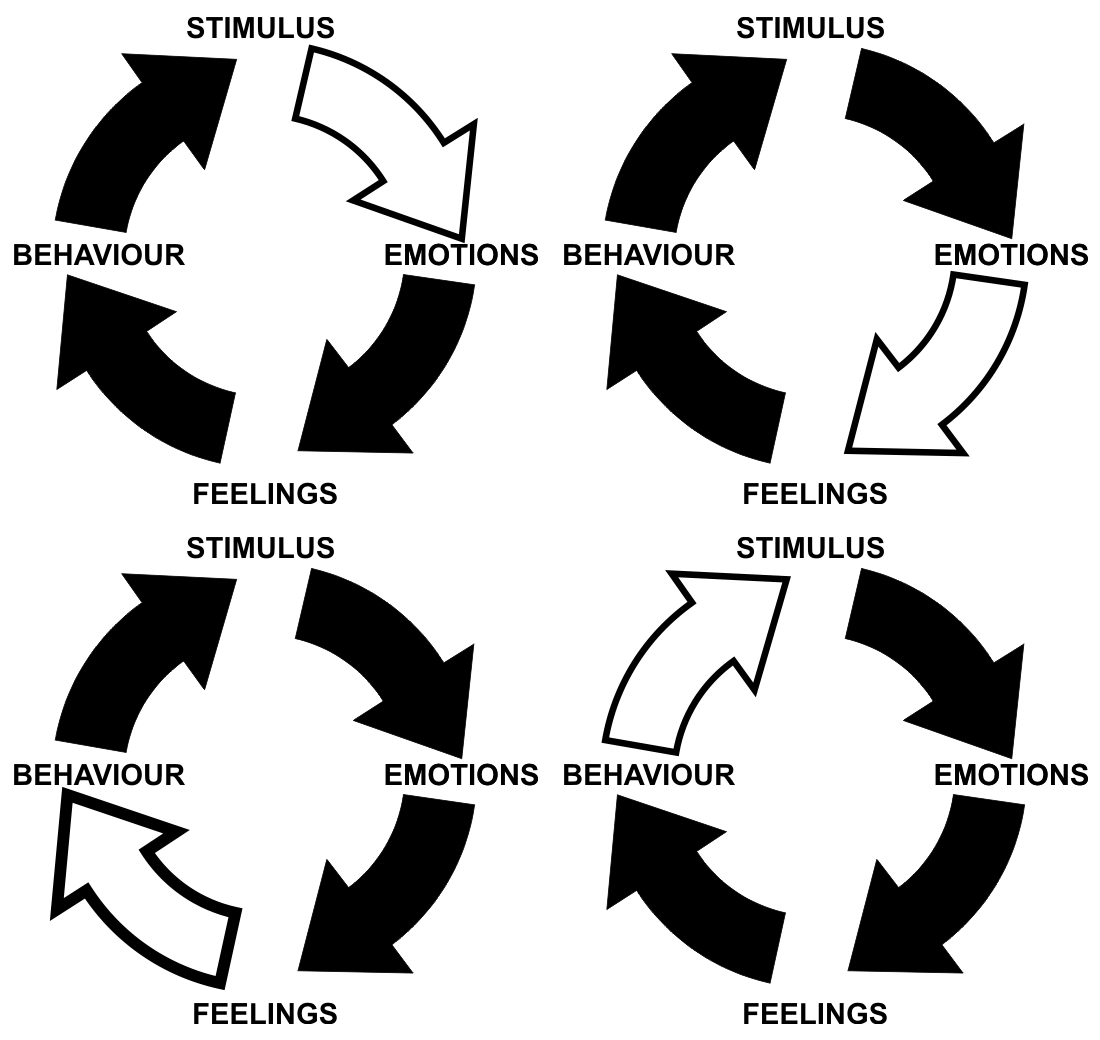
that I can choose whatever emotion I want for myself, anytime, anywhere, at any level, from any stimulus or environment. I can also choose to accept or reject any emotion from
someone else.

I don’t think that we are a victim of our emotions, I think we are a victim of our own choices. Choose well.

Posted in Agreements | Leave a comment

Convincing Ourselves

“In most debates, people seem to be trying
to convince one another, but all they can
hope for is new arguments to convince
themselves”      Nassim Nicholas Taleb

Posted in Agreements | Leave a comment

Unavoidable Emotions or Not?

My rough take on what some Positive Psychologists call unavoidable emotions.
Here is the quote from one such academic from Harvard sent me:

“The fact that we have emotions is unavoidable.  No person is exempt from them.  I consider these emotions.”

My reply was this:

“Could we agree that it may be just possible that nature could create a mutation, that could allow someone to avoid/eradicate their anger and jealousy. Just to allow the possibility that anger and jealousy could be avoidable in a possible future?  Or are you saying that you think the having of anger and jealously are unavoidable forever, and even outside your realm of knowledge and understanding, on what may be possible? I think that dogma is when we think that our “unavoidable” is the universal unavoidable.”

Needless to say I didn’t get a reply.
My answer would now be the following: “That you seem to think that your emotions are unavoidable but I think I can choose my emotions and my life. And I can do  this by choosing the stimulus in my life. Even with death I can choose how to react to it.”

To me, the idea of using the word “avoidable” and “unavoidable” with emotions sounds a bit like Pavov’s dog trying to avoid being given a shock. Why not look at emotions as something that we can create or eradicate ie choose instead of cowering in the corner hoping something does not pop up? A more active approach than a reactive one.

Maybe we can choose and even create our environment/stimulus that will alow us to choose our emotions, feelings and behaviour that we want. Just a thought.

Posted in Agreements | Leave a comment