Saying the Wrong Thing

Can someone say the ‘wrong’ thing?

A small question but one that could change our lives, I think.

If you answered yes, then there is a good chance that you think that we can also say the ‘right’ thing. Applying this type of ‘right and wrong’ thinking, with people, is not ‘wrong or right’, but can lead some problems and is the reason that I have written Rethink Perfect.

I do not believe that there is a ‘right and wrong’ way to speak. That if I did not happen to like what or how you said something to me, I would simply let you know what and why. This would be great if you could do the same with me and we both would not have to worry about or fear getting it exactly or perfectly ‘right’.  This would encourage more ‘open’ and ‘honest’ conversation and hopefully result in resolving issues before they became disputes.

Frustrations, by their very nature, seem to involve small issues that occur repetitively over a period of time. Nipping, such issues, in the bud, reduces frustrations, I think.

This is one of the first premises or agreements of Rethink Perfect. If this did not sound too strange then we could move on to the next premise whis is a more detailed way of carrying out the first premise above.

Posted in Agreements | Leave a comment

Love and Hate

The oppisite to love is not hate, it is indifference or ignorance.

Posted in Agreements | Leave a comment

Three Reasons for the “Illusion of Control”

The Dance with Chance authors suggest that there are three reasons that we should be aware of the
“illusion of control”:

1. Beliefs are usually proven wrong, eventually

2. Human Error

3. And Vested interests

I say:

“Science is not an exact science!”

Posted in Agreements | Leave a comment

The “illusion of certainty”

Gerd Gigerenzer, Author of Calculated Risks: how to know when numbers deceive you,

explains that we cling to our “illusion of certainty” because the medical industry, insurance companies, investment advisers, and election campaigns have become purveyors of certainty, marketing it like a commodity.

For example, it is said that a mammography screening reduces the risk of breast cancer by 25 percent. But in absolute risks, that means that out of every 1,000 women who do not participate in screening, 4 will die; while out of 1,000 women who do, 3 will die. A 25 percent risk reduction sounds much more significant than a benefit that 1 out of 1,000 women will reap.

Posted in Agreements | Leave a comment

The upside of uncertainty and how we like to be treated

The upside of uncertainty between friends colleagues and lovers
is learning to explain how we like to be treated in a certain way or detail.

When I ask this question, “How do you like to be treated?” my prediction will be stunned
silence although last night I got “to be respected and worshipped”.
Upon rethinking what will we get…?

ie What is “respect” & “worshipped” to you?

So maybe the sub-title of this book is:

“The Upside of Uncertainty and the Certain Way we Like to be Treated”

Posted in Agreements | Leave a comment

Competitive Thinking

Is thinking competitive?

If it is then maybe the only time that conversation is not competitive is when we are not thinking while conversing or conversation by script or by rote.

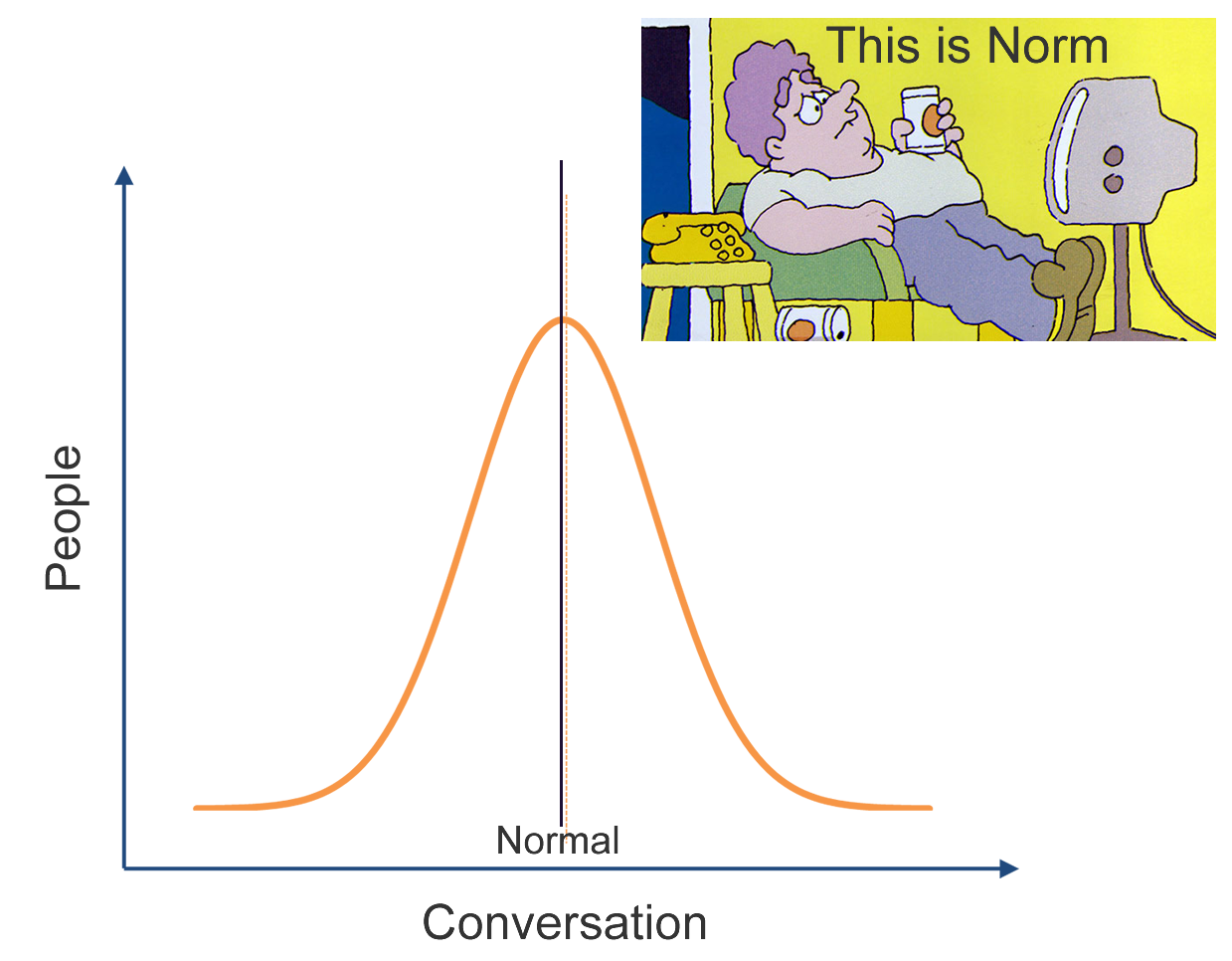
I wonder if it is possible to find the worlds most normal conversation.
I propose an experiment where we tally up the most common questions asked when we first meet someone. The goal being to find the most normal (and predictably boring)
conversation. ie.

  • Q. How are you?
    • A. Fine thanks
      • Reply. Awesome!
  • Where do you live/where from
  • What do you do
  • Are you married
  • etc etc

Posted in Agreements | 2 Comments

Why are We More Advanced than Apes and other Species?

Do apes have explicit agreements with each other? I don’t think so. I think they lack the language to make such explicit agreements and they live a more implicit existence.

Do people have explicit agreements with each other? Once again I would say more implicit generally, relying more upon politeness, conformity, customs and culture to keep each other in line. But of course as we get to know each other more explicit agreements are formed, for example signing the agreement on a marriage certificate is pretty explicit not to have sex with anyone else.

Maybe this is what makes us different than apes that we form relationships based upon explicit agreements rather than solely relying upon implied ones.

If this was the case then the more explicit agreements that we formed and used then the more advanced from the apes we are, maybe.

I wonder if I can get this explicit agreement any such advanced humans?

Hmmm… what do you think? Please share your feedback.

Posted in Agreements | Leave a comment

Thoughts on my ebook title

The Upside of Uncertainty Between

Friends, Colleagues and Lovers

The good thing about this title is that it poses the question:
What is the upside of Uncertainty between friends, colleagues and lovers?

· The answer is that it creates conversation which can be fun if done fairly

· It gives us something to do

· It helps reduce it (uncertainty) and control its effects.

· It gives us something to work on together

· It will be around a life time (maybe) so no shortage

· It allows us to face our fears of losing self and other

· It’s all that I seem to know, when I think about it.

Posted in Agreements | Leave a comment

Why Converse?

Do we converse to seek an agreement?

agree

verb (used without object)

1.to have the same views, emotions, etc.; harmonize inopinion or feeling (often followed by with ): I don’t agree withyou.

2.to give consent; assent (often followed by to ): He agreed toaccompany the ambassador. Do you agree to the conditions?

3.to live in concord or without contention; get along together.

4.to come to one opinion or mind; come to an arrangement orunderstanding; arrive at a settlement: They have agreed onthe terms of surrender.

5.to be consistent; harmonize (usually followed by with ): Thisstory agrees with hers.

Posted in Agreements | Leave a comment

Conversation Competitions

Can one lose or win a conversation?
I guess there are many reasons that people have conversations but I do believe that there is an ultimate goal of finding solutions. When egos come between people, “winning” and avoiding “losing” can take precedence over finding solutions, maybe.
My definition of what conversation is for is to “convert concepts into possible solutions by getting agreements”. These solutions, in the form of agreements, can be tainted as we allow our egos to override the ultimate goal.

If you participated in this conversation could you win or lose it?
Why not try and see. Or maybe that is why most people do not participate in such types of conversation, as they are afraid of “losing”. I think we can only really lose by having such a fear of losing and not participating because of it.

If Conversation is Competitive What is the Goal?
I think it is competitive and I also think the goal is to deliver the better content with the best delivery. For example, a great delivery but not so great content is something like:
“I think the world is flat according to the information that I have available to me”.
On the other hand great content but not so good delivery is something like:
“Your wrong mate, I have seen to world from a plane and it curves!”
The best delivery and content, to me, would be something like:
“From my experience and various other resources, I have formed the opinion that the world is round, but apparently not perfectly.”
Game, set and match!
Finally, getting an agreement (Reasonable Certainty) on the content through the fine delivery, is the ultimate goal, maybe. Any takers?

Do we need rules of engagement to make conversations fairer?
Controlling our egos can allow us to find these solutions and agreements more efficiently. I am proposing we use a 6A framework as part of these rules of engagement for controlling our ego.

Loyalty and Taking Sides
With every good competition comes a chance to take sides or sit on the fence. Changing one’s  mind is an option but can be seen as a sign of losing rather than gaining insight.

Points
You even have points in conversation.
That is good points and bad points 😉

The Bluff
As with every competition, the bluff is an important tool to defeat one’s opponent.
Using factive verbs and certitude, such as stating “This is so…” as opposed to “I think that this is so…” or the old favorite “absolutely…” as they know something is absolute.

Cheating
With every competition there is the possibility of cheating. Cheating is going against the spirit of the game. Even if agreed rules are in place we need to keep an eye on each other similar to how it is done in golf with each player marking the others score card.

Loser
How many times have you just met someone and thought they were a “loser”?
Obviously not a “winner”.

Is Sex competitive?
Well we all know it is a race to see “who comes first!”

Can you name something that is not competive?
Painting? Well we have the Archibald prize for portraiture in Australia.
Writing? What about the Booker Prize?
Why do some people find it difficult to realise that conversation can be competitive also?
Or is that part of the nature of this competition, that even some of the candidates are not aware that it is a competition and therefore not prepared for such an event. That would explain why there are so many losers from this competition in the form of broken relationships and with so many repeat offenders.

Competing against oneself
To behave better than your last encounter

More Competitiveness 
Good looks, botox,  breast implants, facelifts, fashion, all part of how we compete.
Height, weight, age, occupation,  place of residence, even the car we drive are yet more signs of “winning” and “losing”. Accents and how we say something lets us compete even further so why shouldn’t what we say during conversation also be competitive. Well I think what we say during conversation is probably the most competitive of all of the things I have mentioned.
Unfortunately for most, “awareness” has been deemed a handicap for me or anyone else that wishes to enlighten themselves, with the less aware telling me that I am “thinking too much” or “too deep”. I guess it is all part of the competition and their way to try to win and deem others as loser. A bit of irony to me.

Two More Competitive Questions
Is awareness competitive?
And is conformity competitive?
If conformity is competitive then if one wins at it does it effect our awareness ability?

The End! or the end of the beginning.

Posted in Agreements | Leave a comment