Fear of Failure Can Cause Compliancy

I recently had a chance to have an experimental conversation where I explained what I am trying to achieve from a conversation.(ie Non-judgmental expression from them and from me)
I explained to her (a sixty year old intelligent and vibrant stranger at a cafe) about the 3 things I listen for i.e. Adjustable, Accountable and Acceptable language, in the context of what the dogma of the Norwegian terrorist can achieve. She agreed with my understanding.

Then she mentioned that there still was a need for “truths” or dogma.
At this point I failed in my experiment unbeknownst to me until rethinking the conversation last night. Anyone interested I will let you know how I failed.

I think our compliancy can come from not knowing how to approach a conversation without either suffering from the judgment of others or contributing to the judgment of others during the process. Thinking that it might be better to say nothing, that way we can’t make a mistake.

Posted in Agreements | Leave a comment

The Banana Republic Letter to Julia Gilliard

I like what you are trying to achieve with your carbon tax, but if you want to win some friends I really think you should do something about the price of bananas. Imagine living in a tropical area like Qld and for one year of paying $15 a kilo when people in Europe can buy bananas for $1 a kilo. This is totally outrageous. This protectionism of banana farmers is ridiculous when it means we have a cyclone, which we have had for a 2 out of 3 years and such outrageous prices.

I am not one to normally complain about such food stuff but if you wan to win favor with the mums and dads of Australia, allowing them to buy our favorite fruit is an essential in my book.

Please consider doing something about this problem as apparently we have another 6 months before the availability of bananas will mean reasonable prices again, hopefully, if we don’t have another cyclone this summer.

Posted in Agreements | Leave a comment

Rethink Perfect Synopsis

· Ch 1. Adjustable Agreements: are flawed agreements as they are made by flawed people for flawed people
Therefore they can be adjusted at any time by forming a new agreement.

· Ch 2. Six Adjustable Agreements: To do this will require Adjustable Agreements to rules of engagement for resolving disputes during the process.
Three Listening for, and three Speaking with, rules to be agreed to are

o Listen for: Adjustable, Accountable and Acceptable

o Speak with: Appreciate, Apology and Acknowledge

· Ch 3. Our Desire to be Always Right: These rules of engagement are needed during this process and because of our desire to be always right and thinking that we are.

· Ch 4. Conversations and Conversations: Once these rules of engagement are in place and agreed two we can use them to improve our understanding of the agreements
and modify them to suit but also to discuss any other subjects that interest us.

· Ch 5. Relationship Treaty: This process can also be used to find and secure a partner in relationship.

Posted in Agreements | Leave a comment

Agreement Oscillation

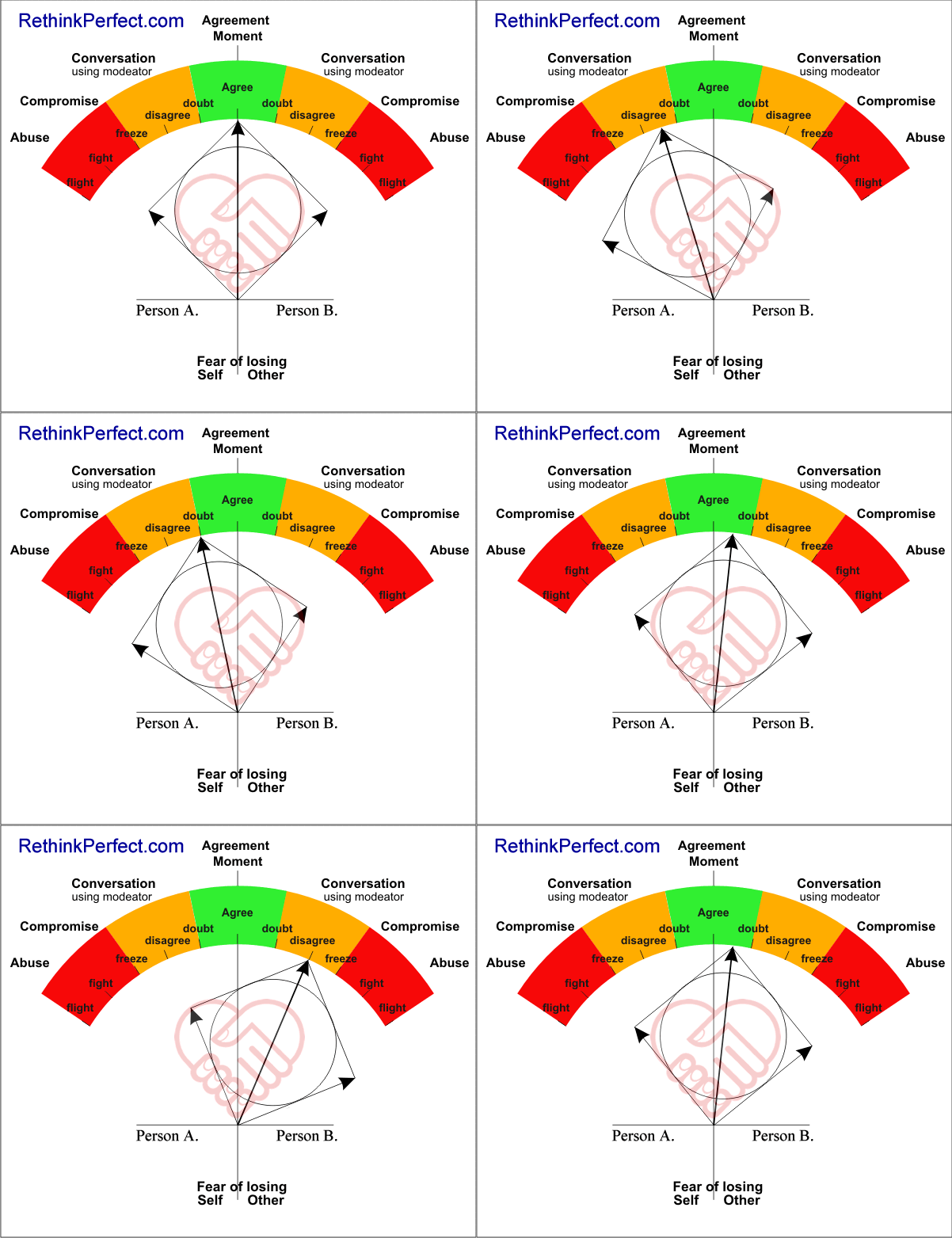
Here is an example of a healthy agreement oscellation.

Healthy Agreement oscellation


Here is an example of an agreement oscellation. Going into the red zone is fraught with danger and deforms the relationship.

Posted in Agreements | Leave a comment

So what is your verdict of title?

1.RETHINK PERFECT: The Hidden Benefits of Flawed Agreements — How Six Adjustable Agreements Can Change the Way We Relate

or

2.RETHINK PERFECT: The Hidden Benefits of Uncertain Agreements — How Six Adjustable Agreements Can Change the Way We Relate

This changes the way I approach the whole book now. It is not the content of the agreements that are so important as the style of the agreement ie Adjustable, because they are flawed just like me, (possibly)

This also fits in the way the whole approach to science is now, in that it seems with Quantum Mechanics, that nothing can be considered certain even the existance or position of matter. Uncertainty Principle

Posted in Agreements | Leave a comment

Butter Chicken Perfection

Steve I just bought a bottle of Butter Chicken paste

and cooked a pot of Butter Chicken with Brokley , Brussel Sprouts and potato
with rice.

Steve this is the best meal I have ever cooked in my life and worth putting on my blog

I have discovered Perfection!!

Posted in Agreements | 1 Comment

Six Agreements for Better Conversing

What are these six agreements that are going change the way we relate, forever?
Obviously this is my subjective view but let’s see what you think.
The six agreements that I am hoping to get with you are broken up into two parts.
Three for listening with and three for speaking with.
The Listening for agreements that I am proposing are:

1. Adjustable

2. Accountable

3. Acceptable

1.That is we agree to use Adjustable language when we are conversing or making our point.
Examples of this are reminding each other that these are only our opinions and prefacing our statements with “I think…” or “to me” etc. No room of absolute language like “that’s perfect”, “it can’t be done” or “that’s impossible” without these prefaces. At any point we can enquire if the other person is still speaking from opinion rather from fact.

2. Accountable language being pretty self explanatory in that we take responsibility for what we say or do and not attribute things to others. For example “You make so frustrated” changes to “I get frustrated when we talk about this”.
No room for victims and persecutors. We make our bed and we lie in it.

3.If we find something that was said that we did not like but were unsure as to why we do not have to accept it and can let the other know that there is something wrong and we will get back to them on it. It might very well be that someone used very cleverly worded language that was not adjustable or accountable but we need some time to work on it.

For Speaking with I have three other agreements that I am proposing for better conversing:

1. Appreciate

2. Apologise

3. Acknowledge

4. Appreciate works by us remembering that no matter what is said that we cannot converse in a vacuum. That we cannot expect to hear perfection or even what we consider perfect. If we notice that the delivery is not adjustable or accountable enough for us we can let them know by first thinking them for their feedback and explain how we think their delivery can improve according to the first three agreements.

5. Apologise: If one of us lose it (the plot) then we and the relationship has lost it (the benefit). The Apology is for both of us do in response to this loss. Now granted one person is more than likely to seem to initiate this break down but we are both responsible for ensurng that it does not happen. So when it does happen we are both responsible for making such an apology. One for the overt aggression and the other for contributing and not spotting it early enough to prevent it getting to that point. The Apology consists of what I did, why I did it and what I will do (try) next time. Obviously to apologise to this level would take a lot of humbleness but the benefit is more for the person making the apology than the receiver. By reminding us how we can do better and avoiding blaming the other person for what occurred. As the saying goes “It takes two to tango”.

6. Acknowledge each point that is made when conversing. This requires discipline and patience on both sides not to introduce too many extraneous topics into the conversation until each issue is dealt with.

This is a basis of this book Rethink Perfect and how we relate with each in the course of improving our concepts and knowledge through conversing.

If anyone can explain why these proposed agreements would not be effective in improving conversations
especially when disagreements occur then please let me know and why and I would love to hear your opinion.

As we have not got any of these agreements at this stage can we please try to resort to common courtesy when replying to this post until such agreements are achieved.

Posted in Agreements | 1 Comment

Rethink Perfect as Summarized by Luis Edgardo

Converse: Verb:
1. Carry on a conversation
Converse: Noun:
1. A proposition obtained by conversion
Converse: Adjective:
1. Of words so related that one reverses the relation denoted by the other
2. Turned about in order or relation
[WordWeb.info]

The proposed system, Rethink Perfect, redefines what is thought to be ‘normal’ conversation by encouraging clarification of the agreements by which conversation is typically conducted.

Conversations are typically entered into with an undefined set of tacit (unspoken) agreements. These unspoken and thus not fully conscious ‘agreements’ are often at odds with each other between conversational partners. This often leads to misunderstandings, argument, and failed communication.

The author, Mr. Desmond Sherlock, proposes a ‘converse’ approach. That is to say, a reverse approach to conversational interaction. Rather than rely on tacit agreements of conversation, one begins conversations explicitly stating the ‘rules of engagement. Although this may appear a daunting task to most, Mr. Sherlock suggests that it is not as daunting as it may initially appear.

At the heart of this new approach to ‘conversing’ is the idea that one reverses the communication offered by another by applying a set of converting tools. These are labelled the 6 A. Accountable, Adjustable, Acceptable and Acknowledge Appreciate Apologize.

Mr. Sherlock suggests that the use of a formula mix of these 6 tools will resolve problems of communication. He offers a set of key phrases that need be inserted into communications for the communications to be successful in avoiding ‘clashes’ of personalities. Mr. Sherlock is currently taking his e-book and theories out for field testing.

Critique of the book has been suspended, due to clashes with an unruly student foolishly attempting it. However, discussions are still open for those who agree to follow the explicit agreements required and follow the proposed rules. This is a must for if the rules are not followed communications break down.

Posted in Agreements | 1 Comment

I’m Confused

1. Can I blame someone else if I am confused, by what they say or write?

2. What should I do if I am confused?

3. Can I expect not to be confused?

4. Can I confuse others or do they allow themselves to be confused?

5. How does confusion work and does it take at least "two to tango"?

6. Who is responsible for confusion and if we find him/her will this stop my confusion from now on?

7. Can de Bono’s tools stop/reduse my confusion or will they just add to it?

8. Is confusion possibly the beginning of learning or the end?

Any opinions one or more of these questions would be appreciated

Posted in Agreements | Leave a comment

An Eye for an Eye or Turn the Other Cheek

 Is it acceptable for someone to use provocation to explain away their aggression?
The answer to this question can change our lives, I think.

For most of my life I thought that “I got what I deserved” and if I was being provocative and someone got aggressive towards me, I couldn’t complain. On one occasion I even apologised to my ex for being provocative, when she gave me an almighty whack to the head, when we were at a bar. Unbeknownst to me, by doing this and not getting her apology also, I continued this myth. After this incident, it meant that if she also provoked me, I had the right to smack her, which I did.

This was a huge mistake on both our parts, I think, as the aggression in our relationship escalated with me taking an active part in returning her aggression for aggression. As you can imagine, the relationship soon disintegrated.

Now I have a dispute with one of my brothers who also believe that aggression is warranted when one is provoked and today my mum endorsed this. “You did sort of provoke him Desmond”, she pointed out as a justification for his aggression. I admitted that I did provoke him, and wanted to apologise, but to me, no aggression is acceptable or justifiable. Understandable? yes, acceptable? no.

I wonder how many others think that they can justify their aggression by how they are treated?

Posted in Agreements | Leave a comment