What is Balance?

Here is a thought,
What is balance?
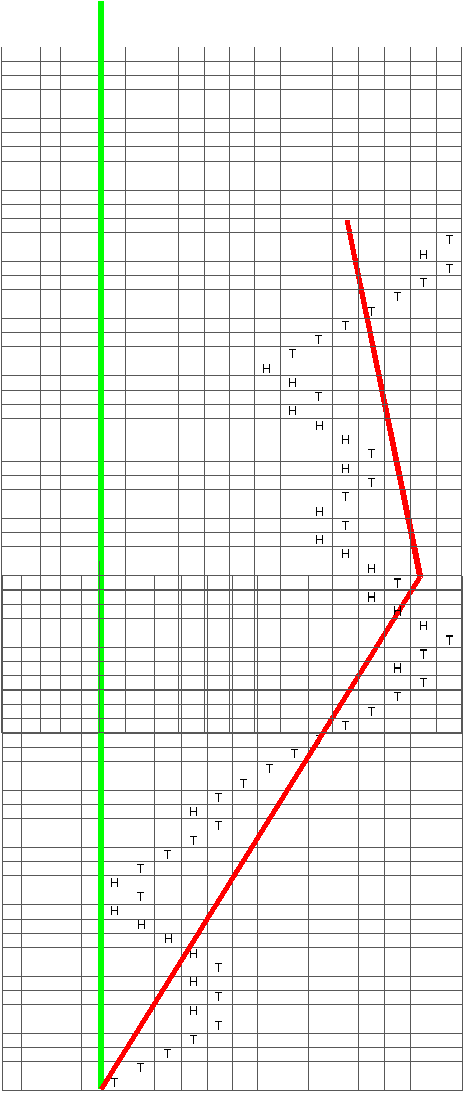
If you tossed a coin you would expect to get a balance between Heads H and Tails T.
Here is one I prepared earlier.
The H moves the line to the left once and T moves the line to the right once.
The first T at the bottom was the first toss and T dominated the trial
The green line here is what I would expect to be the balance line
between H  and T, but after 36 throws I got the red line as the balance

Does this mean that balance does not exist? Or is there two balances?

Of course the theory goes that over time and after enough phases or trials that the red balance line (real or random), would converge towards the green balance line (ideal or perfect).

So maybe the same applies to “balanced conversation”. That at any one time we are in a red line balanced conversation and it is only over time and many phases that we get close to a green line balanced conversation.

Simply put maybe our idea of balance is a lot different than natures idea of balance.

Trial 2

Posted in Agreements | Leave a comment

Half Full, Half Empty, Thinking

We might all claim that we are more half full thinkers than half empty. I guess this is half of the problem. But how does this type of thinking translate into conversation?

What about this?

When we have half empty thinking we would be more likely to start a conversation with
something like “I don’t appreciate that you….”

With half full thinking we would be more likely start a conversation with
something like “I do appreciate that you……, however I would even appreciate it more if you did this…..”

I think that appreciation is one of the operative words for half full thinking. So if we fail to appreciate someone else’s thinking and/or behaviour then we are half empty in our thinking.

Posted in Agreements | Leave a comment

Understandable But Not Acceptable

· So we all know that murder is understandable but not acceptable (funny in this case it is the “understandable” part that is a problem in our thinking. This is because a judge will take into account the circumstance of the murder as to the punishment.)

· Assault is understandable but not acceptable also

· These two are part of the law but because we have not made anger illegal
I guess some people still think that it is acceptable ie they become a law unto themselves.

· When I say that I think that anger is understandable but not acceptable, this is not a law per se but an agreement that I am looking for with people that I wish to have deeper relationships with.

Posted in Agreements | 8 Comments

Somebody Versus Somemind

The problem with the human mating cycle is that we are looking for somebody, when, in my view we should be looking for somemind!

Posted in Agreements | 4 Comments

Informal and Formal Conversations

Informal Conversation

Why do we converse?
Is it for our own benefit or for others?

It is a tough question but I think I have the answer.

I converse to convert my ideas or concepts using other people’s feedback.
So if I don’t get feedback, I don’t get to convert my ideas and don’t learn
during the conversation process.

So I converse for my benefit but if I am conversing with someone that
equally understands this principle then they have as much chance to
convert their own ideas or concepts and converse for their benefit too.

There seems to be two forms of conversation, formal and informal.

Formal goes something like this.

“Hello, what is your name and where are you from?”

“Hi, my name is Des and from Australia. What is your name and where are you from?”

“My Name is Nora and I am from Germany.”

“How long have you been in Australia Nora?”

Etc etc. Boring and predictable but it is something but not very much chance of converting
each other’s own ideas because we get pulled along by each other’s questions.
Of course a formal conversation could develop into an informal one but in my experience
a formal approach rarely gets into the informal as most people that participate in
formal conversations are not so consciously aware of the possible converting process of a conversation.

The informal conversation is a piece of art and a great opportunity to share and convert.
It goes something like this:

“Hello, I noticed that your t-shirt says Chicago. I have always wanted to go there and
ride one of the cross country trains and meet some hunky yank if I get lucky, is that
where you are from.”

“No, my x-girlfriend is from there and I like to still wear it so that I can remember never to get myself it the same type of relationship ever again. You seem pretty desperate to find a guy, to me.”

“No not really, I am just open any opportunity that comes my way, hunky American guys is just one of them.”

“Oh yeah, well I am from Dallas and 6 foot tall but as I said I am not about to repeat my last mistake but I am open to a conversation”

“Shoot!”

Correct me if I am wrong but the informal one sounds so much more interesting and with so much more of a chance to convert our own specific concepts and ideas as we direct the context. It seems that the more one gives the more one can gain or convert from such a conversation.

Think about what I have written here and see if it applies to your approach to conversation. And next time you have a chance to start a conversation with a stranger try the more informal approach and see what you actually manage to convert from the experience. Or any feedback that you can offer on this topic to help me convert it would be much appreciated.

Posted in Agreements | 2 Comments

Why relationships are stuffed

Why I think that most relationships are stuffed

Posted in Agreements | Leave a comment

Getting Mad & Going Mad

Getting Mad Going MAd

People are getting mad and going mad in hoards.

I reckon that if you listen to how a person speaks and you can detect and measure how mad a person is.

A friend of mine told me yesterday, “My previous boy friend was a psycho!”

I suggested to her that it takes a psycho to select a psycho and to stay with a psycho, but she was not convinced.

“But sometimes he treated me so cruelly”

I suggested that she allowed him to do so.

She was not convinced.

She was acting and speaking with so much anger regarding him or so mad towards him
that I believe it actually made her, in effect “mad”, to that degree.

The degree of anger we harbor or how mad we are towards anyone (including ourselves) or anything, I reckon, is the degree that we suffer a mental disorder or in effect mad-ness.

Posted in Agreements | Leave a comment

Conversation revisited

What about this:

I propose that conversation is “A” learning process by which we

convert our own concepts, through other people’s
feedback, into FUTURE agreements. (and vice versa)

That the feedback we receive today may take up to 5, 10 or even 20 years to convert,

so the learning process might not be so obvious to some. Or for some, they refuse to
convert the feedback and fail to learn. In this case, where no conversion occurs, I would
be willing to say that no actual “conversation” or conversion took place. I am not sure what one would call such a transaction without any conversation? “Sad’ possibly.

“A” learning process, because there are many other types, ie reading, trial and error
pattern recognition and general experiments.

I have come to this conclusion by recognising the pattern that occurs after conversations.
ie I get new and improved ideas, and by some experiments and trial and error.

Posted in Agreements | 2 Comments

The Two Resentments

Two Resentment

Two Resentment

Let me run this by you.

Before we get angry or sad, we get resentment.

For example, say a driver in a car does not give way to us.
We can get 2 types of resentment from this experience.

1. Resentment that the driver did not give us something
(in this case, the way)

2. Resentment that we did not get what we wanted
(ie to be in a desired position at a specific time)

These resentments can then effect what happens next (hope he dies in an accident) and how we feel (angry and sad) for potentially years after, depending on the circumstances.

Lets look at Resentment 1: Why do we think and expect that this unknown driver/person
is going to give us something, out of the blue? We do not know this person and have no agreement on how we are going to behave with each other only some road rules to guide us.

I say that it is because we have been expecting others to serve us since the first day that we were born. And unfortunately have not learnt or been taught yet that our expectations are understandable but not acceptable (especially to others).

The 2nd Resentment is more curious in that we end up resenting ourselves indirectly.
It is a bit like standing out in the rain and getting wet and resenting the rain for making us cold and wet, instead of getting out of the rain. I have yet to understand why we would embark in such behaviour but I do believe that most of us bask in these two resentments to varying degrees and at varying times.

Isolating and understanding them can help us in our resentments and our quest to reduce anger and sadness in our life, I believe.

Posted in Agreements | 1 Comment

Titanic Relationships

Life is like the romance in the Titanic Movie, most couples end up
in deep water, thrash about, freeze and then sink.

Posted in Agreements | Leave a comment