
Steve this is for my blog.
What do you think is the difference between a discussion verses a conversation?
I have my own personal idea, of course.
Steve this is for my blog.
What do you think is the difference between a discussion verses a conversation?
I have my own personal idea, of course.
DES said: When you split up was part of the reason was because you wanted
a 3 step apology? Well I do remember thinking that at the time you couldn’t even get a 1 step apology! So now what would you say about this in light of (our latest understanding) of Accountability?
Anonymous said: “We didn’t have an agreed way to discuss and resolve stuff.”
To me, that is still a bit like saying the reason the plane crashed is because it fell out of the sky. In this context, I think you both did not have one of the 6A Framework agreements that me and you have. This one being Accountable, what it entails and how to address it when either of you fail.
That is, me and you have agreed how to “discuss and resolve stuff” by to splitting it into 6 parts, (3 for listening to the speaker and 3 for listening to the responder) and have the overall governing agreement that any anger during the process is understandable but not acceptable (hence back to accountability if anger occurs and the 6As help us to detect and moderate it).
So the 6A framework, to me, is about moderating/governing/measuring our levels of anger during a conversation and holding us accountable throughout the process, which in turn reduces anger on both sides.
For example if someone responds to a comment by saying:
“What makes you think a discussion about our relationship boundaries didn’t happen??” This, to me, feels like it is the beginning of anger by its rhetoric, yet without an agreement on accountability, I did not have the courage to address it.
Having an Accountable agreement which includes rhetoric, allows us to point out the rhetorical question and ask them to be more accountable in their delivery, using the agreed 3 As for responding.
ie. “Thanks for your question however it seems to me to be rhetorical. Can you put it in a way that that will encourage me to respond more constructively.”
See, this rhetorical approach is a villain here, as it tries to cloak or dress up our anger, expectations and resentment. What a more acceptable response (if I had of had the courage to discuss her rhetoric and get an agreement) would have been if she said:
“Des, I think that you are assuming that our boundaries were not discussed”
To me this is a much more up front and friendlier approach than “What makes you think….??” and could very well be one of the reason that her friend left. As without discussing and agreeing to this boundary of rhetoric and accountability in general during a conversation I think a conversation and the relationship it comes from are doomed to be compromised.
So the real villain here is, I think, that without having these agreements on how we hold each other’s anger to account, that what starts out as a spark, is enough to make us retreat from all attempts to communicate, out of fear of a full blown bushfire resulting.
Steve when you split up was part of the reason because you wanted
a 3 step apology?
Well, I do remember thinking that, at the time, you couldn’t even get a 1 step apology!
So now what would you say about this in light of our understanding of Accountability?
I read a very interesting theory called Not Invented Here (NIH), Dan Ariely writes about it in his book The Upside of Irrationality or you can see more on it on Wikipedia where people, and organisations are more interested in and likely to adapt their own ideas rather than someone else’s, regardless of the quality.
But with regards Rethink Perfect it can work in my favour as RP seems to take NIH into account and forces me to continue to simplify the concept until even the NIH people will choose to adopt it.
Looks like I have a long way to go still to convert my ideas.
In Taylor Clark’s book Nerve he refers to psychologist John Leach’s research that some 15% of people in a crisis will stay cool, 15% will fall apart & some 70% will act like lost sheep waiting to be led or misled.
The good news is however, with a bit of preparation and training most of us can act responsibly during a crisis. In other words fail to prepare & prepare to fail.
How about this for a police blitz. Two female police officers and their police van were staked out around the coner of Hedges and Peerless Avenue, stalking boys and girls on the bicycle path and instantly booking them even if they are overseas visitors and did not know the severity of the law in Qld.
That is exactly what I witnessed while I was riding there this afternoon.

Yes folks your taxes at work. But worse still all along the path boys and girls on the bike path were warned about the cops were down the end of the road so they were fleeing to the safety of the roads to avoid them.
“Come on” I told the cops but it just seemed like a revenue raising outing for them. With no warnings handed out to anyone stopped. At one point there was a crowd waiting for a ticket. What a joke. “We are just doing our job” they said, so I guess their sargent told them to do some stalking and raise some money. See I have a doctor’s certificate which allows me to ride within the law but these boys and girls do not know any different. Australia is one of the only countires that makes bicycle helmets mandatory by law.
With all the shootings happenng on the Gold Coast (BTW they were parked within 300 metres where the bikie gang shooting happened just last week) surely these police have better things to do on a May day afternoon? What are they thinking?
Bag a real Bikie Gang shooter not boys and girls on bicycles I say!!!
I just came from a not so perfect date but I met her through my marketing ploy, and it goes like this.
I have just completed my book/manual called Rethink Perfect: The Upside of Uncertainty and the art of moderating our own disputes.
As it is a book about and for me and my mating cycle, I created a profile on a popular dating site here in Australia called RSVP using the title of my book as my profile handle, Rethink Perfect.
http://www.rsvp.com.au/profile/display.action?handle=rethinkperfect&uid=3115353
I used my profile to explain the idea of the book and referred to my blog by the same name Rethink Perfect. Although this is not really allowed, I got away with it. The woman that contacted me said that she loved my profile and even more loved my blog and so I gave her one of my books as a present on my date.
She said that I was using my profile to market my book but I explained I use my book to market myself!
Anyway, obviously this type of marketing would not suit every author but it shows a lateral way of thinking and marketing.
Just reading a book last night called Nerve by Taylor Clark and he talks about the story of how this prince came to enlightenment some 2500 years ago (now called Buddha).
Just before he came to this point he realised that his mind was like a monkey swinging
from tree to tree. Once again it is interesting the use of this analogy of a swing for the mind
and how we deal with fear.
Another point I thought interesting is that in his book he more talks about
people in relation to their own fear and how they come to deal with these personal fears.
Where as my concept is much more about how two people connect and deal with their joint fear. This “coordinated fear” (and coordinated behaviour) seems to be left out in psychology books generally but included in economic books much more. Think of phobias like acrophobia, arachnophobia, fear of snakes, hypochondria etc and general anxieties. He does not seem to mention fear of disagreements and our one-on-one fears. Such as fear of losing what we have already with a person and fear of losing our future time with a person.
Fear of non-conformity/peer pressure or fear of not showing who we really are. I think that most of our fears are made up of these one-on-one or coordinated fears. For every connection we make we have associated and coordinated fears, I believe.
How we talk to each other can either exasperate or reduce our coordinated fears.
After all who doesn’t fear being screamed at or being ignored (given the silent treatment)?
Two opposing fears but also both legitimate and can be used as torchure techniques.
i.e. She says “you never do that” and he says ” you always say that”. This feeds our coordinated fears (use of non-Adjustable and non-Accountable language)and creates the resonance that expands in to a full on fight, as we push each other’s thought back and forth.
Think of two people pushing a child on a swing from both sides. The resonance of each action, from both sides, contributes to the swing reaching its highest point much quicker (a heated conflict).
This is the same as the coordinated behaviour I mention in my book with the swing fault in the original millennium bridge design caused by pedestrian coordinated side to side movement.
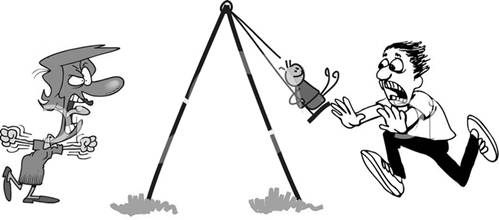
Having a plan to inject non-coordinated movement, from at least one person, is the plan of
Rethink Perfect, through responses such as Appreciation, Acknowledgment and Apology.
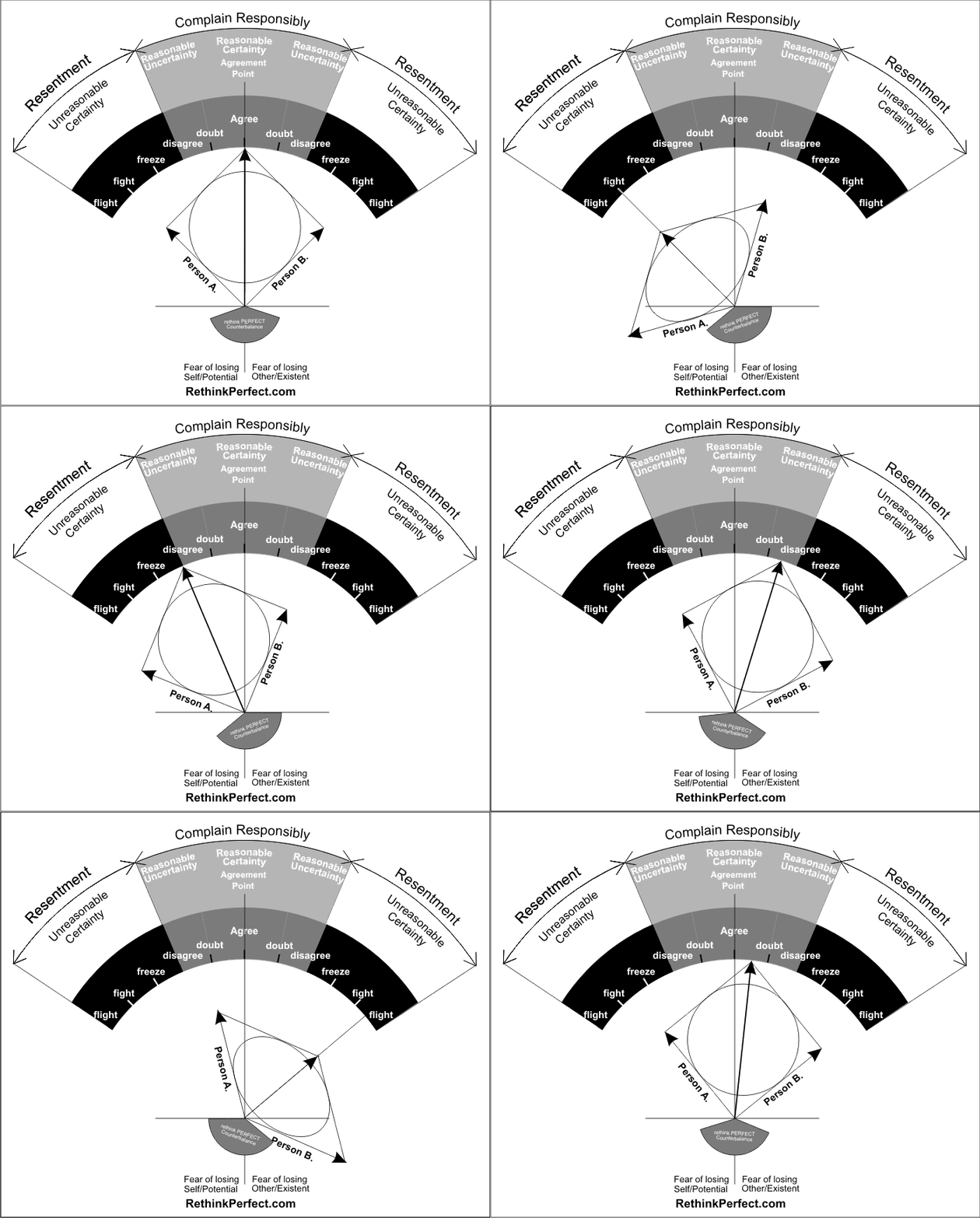
I have taken this swing and turned it upside down as in the diagram below but is still driven by our coordinated fears. And can be dampened using, the agreed to, 6A rules of engagement, counter balance or moderator.
Why do we need to beg when we “beg to differ” or offer “all due respect” when we want to
disagree with someone we are conversing with? Is there an explicit reason for such politeness? I think there is.
I think we inherently fear or have an anxiety response for disagreements and the possible conflict that it can cause. Being so polite, when we do disagree, can help us avoid such heated disputes by priming the other, informing them that we are about to disagree and not to be too shocked. A bit like using the ice breaker, “So…, what do you do?”, when starting a conversation, only they are ice breakers for responding when we wish to dispute
what was said or how it was delivered.
If what I am saying is true and you are aware of these polite phrases too, then that may mean that, as humans, we have been implicitly opted into a pact to inform each other of our disagreements. A bit like how individual baboons are implicitly co-opted to warn the troupe of any impending dangers.
At the same time, maybe we are obliged to offer an opt-out to anyone that does not wish to
participate in this holding of each other to account during a conversation (warning of the troupe). Or it might be a way to find out if we are a member of the same troupe. This may explain the common advice that we should avoid talking about politics and religion at a dinner party. i.e. Explicitly agree to stick to small talk and avoid subjects where there is likely to be any impending disagreements and disputes. (No warnings will apply here).
As a participating member of this “troupe”, the “with all due respect…” process that I would like to offer is to firstly Appreciate your contribution, Acknowledge your point and Apologise for having an opposing view. These are the responding 3 As of a 6A rules of engagement process that I believe are inherently built into our fear response brain or also referred to as our Amygdala. The initial 3As are what I believe we use to listen for or filter, when someone initially speaks with us. i.e. listening for Adjustable, Accountable and ultimately, Acceptable Language.
The following diagram attempts to illustrate these two parts of our conversation, fear
response system that, when skillfully and correspondingly applied, can result in creative conversations that are optimised to share open concepts and diverse feedback.

Putting climate change aside, I think it is fair to fine companies that
polute our water ways and to also fine companies that polute our air.
Good on ya Julia! #carbonfine #carbontax
My defining of actions for respect, trust, honesty and love in
relation to each other, and to us.
RESPECT:
Speaking: Starts with me respecting someone’s ears by speaking
with what we agree is Adjustable, Accountable and Acceptable language.
Responding: Then responding with Appreciation, Acknowledgement
and Apology ie. the process of offering “all due respect” to the speaker
if/when I think they have failed to respect my ears and I wish to
dispute their delivery.
TRUST:
Happens when we agree to respect each other’s ears and as
we successfully put it into action.
HONESTY:
Is the ability to put up our hand when we fail to respect and
is measured in the time it takes to do so and the quality of our
appreciation, acknowledgment and apology.
LOVE:
Is when we can respect without having to
think twice about the process.
 rethink PERFECT