Reaction Reduction Theory

alizzcooper-by-ingo-maurer-75_alizzcooper-table (1)

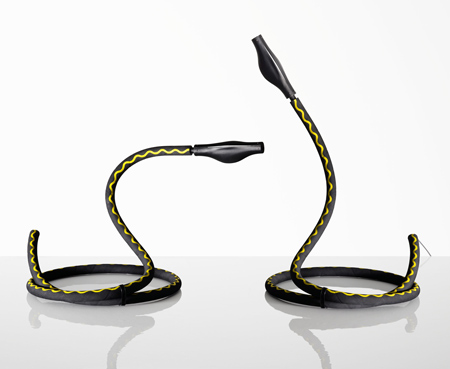
Better to mistake a hose for a snake than a snake for a hose

I am finishing off Antifragile by Taleb and he points out that it is in our DNA to be more reactive or over reactive than under reactive due to the nature of erring on the side of caution or as he terms it Antifragile. In other words we are more likely to mistake a hose for a snake than mistake a snake for a hose.

All those that have mistaken  a snake for a hose were bitten eons ago and are no longer part of the gene pool. All those that have mistaken the hose for a snake were over cautious and had a laugh afterwards, but lived to see another day and were ready for the day that they came across a snake.

So we are all over reactive by nature. But now we need to spend the rest of our lives reducing this tendency to over react so that it is closer to perfect or just-right reaction.

All I have been doing for the last 30 years is trying to understand this process of reaction reduction.

I explained this to my 82 yo mum today and she even gets it.

So for my mating cycle if I meet a girl I will explain this process first and ask her if she wants any help in reducing her over reactions and if she can help me to reduce mine. And that I have some theories on how we can go about it called:

Rethink Perfect – The Upside of Uncertainty and the art of moderating our own disputes.

Steven Pinker reckons that we are less violent or aggressive than any time in history with heaps of stats that back up what he is saying and I think that it is because of this reaction reduction process that we all seem to go through, throughout our lives and loves, to a lesser or greater degree.

Posted in Agreements | 1 Comment

Absolutely, Absolutely, Darling!

absolutely-fabulous

A funny yet interesting experiment was carried out by Professor

John Trinkaus, who is known for dedicating his academic life to

the scientific observation of ordinary people going about their

everyday lives.

In his study “The Demise of Yes”, he plotted the

verbal trends in providing an affirmative response to an

inquiry. Of the 419 questions analysed, ‘yes’ was only used 53

times, whereas ‘exactly’ was the affirmation used 117 times, and

‘absolutely’ appeared 249 times.

Posted in Agreements | Leave a comment

We Could Be Wrong AKA Rethink Perfect

About 25 years ago I made a bet with a girl that she could be wrong about anything.
This was in Galway and she was from Boston and I met her on the plane
on my way to Ireland.

We met up a few days later and in the conversation in a pub she said that she
couldn’t be wrong about the American Declaration of dependence.
I placed 10 punts (Irish pounds) in front of her and said if you can pick it up you win.
She did and I walked out the door of the pub and did not look back.

Tonight I thought about looking it up on Wikipedia and found this:

“The original July 4 United States Declaration of Independence manuscript
was lost while all other copies have been derived from this original document.”

http://en.wikipedia.org/wiki/United_States_Declaration_of_Independence

So it appears that there is no original Declaration of Independence only copies.
Looks like she won the 10 punts and I won the bet.

Posted in Agreements | Leave a comment

The Weakest Link is Our Greatest Asset

If we get the idea that “a chain is only as strong as its weakest link”, that is; all the
links look the same and the only way to make sure it doesn’t fail is to replace the
whole chain before it fails. If we build our philosophy for life around that, then
what is commonly called the “weakest link” 
becomes our greatest asset.

1111This is the premise of preventative maintenance and it is what has made the airline industry the safest mode of travel today. It is claimed that, statistically, a passenger could travel for 14,000 years without being in a crash. And all because parts are replaced before they fail, pilot procedures and systems are put in place and every accident is investigated and used to improve the safety of every other airliner.

The opposite to preventative maintenance, is “If it ain’t broke don’t fix it”.
Some believe that we should leave something alone, avoid attempting to correct, fix
or improve what is already sufficient. (Often with an implication that the attempted
improvement is risky and might backfire and make things even worse.) Wikipedia

Imagine if we applied such preventative maintenance (PM) to how we deal with each
other and our relationships? Daunting as it sounds maybe we could reduce the
horrifying statistics for failed relationship. Rethink Perfect is a preventative
maintenance solution that I am proposing to achieve such a goal.

Don’t believe me that most people think this way about relationships?
What detailed procedures have you put in place to prevent such failures
in your present and future relationships? What methods do you use to investigate failed
relationships? Finally, what have you discovered is the biggest cause of failed
relationships?

If you answer anything like “people grow apart” then, to me, that is like
answering “They fall out of the sky” when asked why do planes crash!

Ask me and I will tell you what I think is the number one reason relationship are failing more than ever before.

Posted in Agreements | 1 Comment

What Makes Us More Than Animals?

If a tantrum is the term used for when a child is overly concerned about their situation.
I wonder if a nervous breakdown is the term for an adult’s behaviour for when he/she is overly concerned about their situation – In other words an adult tantrum.

That if a tantrum is a behavioural problem that needs correcting then maybe, instead of medicalising adult behaviour by labeling it a nervous breakdown we should treat the behavour. (The unfortunate thing  is that we are now medicalising a child’s tantrum by labeling it ADHD)

For example if anger is understandable but not acceptable then maybe the thing that makes us angry, fear, is also understandable but not acceptable.

We know when something is not acceptable when we easily apologise for it. Like hitting an excessively bad shot in tennis, the player is likely to say sorry.
Or if we inadvertantly bump into someone we say sorry or knock over a cup by mistake.

So then why not apologise every time we get angry regardless of the reason? Surely angry behavoiur is worse than a bad tennis shot! Why not let people know that our fear got the best of us and say sorry? By being able to admit our error maybe it will help us correct it.

I think that is what makes us more than animals or even more than Neanderthals in that, just because we may behave a certain way we do not have to justify that behaviour. We can see, if we want to, when our behaviour is  understandable but not acceptable and admit it. We can do what F. Scott Fitzgerald famously said:

“The test of a first rate intelligence is the ability to hold two opposed ideas in the mind at the same time, and still retain the ability to function.”

Posted in Agreements | Leave a comment

Prepare The Way for Honesty

My reply to “100 Days of Honesty” blog post:

http://100daysofhonesty.com/2013/04/14/to-be-honest-i-think-im-conflicted/#comment-524

Brilliant!

I went down the same track as you some 26 years ago and finally got a chance to test the total honesty theory on myself and a willing participant, from 1998 to 2000, in an experimental relationship specifically for this purpose and we failed.

Since then I realised that it takes 2 to tango and that the person receiving our honesty needs to agree and be prepared for it. Enter Rethink Perfect ( http://RethinkPerfect.com ).

I developed Rethink Perfect to help draw up rules of engagement for dealing with our “honesty” or attempts really, to be truthful.

I really think that honesty is only an aspiration and that, as humans, we are not capable of producing or recognising the Truth, but that does not mean that we should not try.

Rethink Perfect is all about trying,… together. It is about relating to others. Not about individuals hurting others and themselves by stating real thoughts out of context or preparation.

For me, Rethink Perfect is about preparing the way for the Truth or a truth.

Posted in Agreements | Leave a comment

What Makes a Good Entrepreneur?

entrepreneur-magazine-june-2012
What makes a good entrepreneur?

I think Time, Timing and Temper

ie
TIME: Patience, determination, and endurance to see the project through to its logical conclusion.

TIMING: To be in the right place at the right time during each transition of the next phase of the company development.

TEMPER: To be able to temper or moderate one’s emotions that both contribute to and fasciliate the Time and Timing process.

Posted in Agreements | Leave a comment

Better to be Grumpy Before than Angry After

While waiting to chekin for a flight tonight there was a mass blockage
in the line, where the people in front had to go back and get their bags checked.

To cut a long story short I let the people know in front of me that I wanted to go through
and that they were blocking the way. “I was here before you” he snided but he had to go back and have his bags
checked and he know it. “Ok let the grumpy man through” he jeered.
And I agreed and repeated “yeah let the grumpy man through” to which I proceeded and finally the way was clear for
the rest of us behind him.

Only later I heard him complaining that he had been in front but had to return to get his bags checked etc.
I retorted “sounds like you’re the grumpy man now.”

Anyway, in Asia airports one never gets anywhere unless one pushes through to some degree.
But I would rather be grumpy now before I get angry rather than complain after.
But that is just me.

Posted in Agreements | Leave a comment

Anger is Understandable But Not Acceptable

In the past, it was acceptable for people to be hanged in Australia, only ending in 1967.

It was also acceptable for school children to receive corporal punishment up till the 1980’s.

These are now unacceptable to Australians by law.

I believe that someday anger will also be seen as unacceptable, not by law but by a moral
or values view point. Understandable yes just not acceptable.

By being “understandable” I mean that there seems to be precursors or warning signs
that we can watch out for (once agreed) to help each other to maintain a more moderate mood.

Disagreement Moderator

Disagreement Moderator

The precursors that helps make anger understandable to me (all begin with A) and are a lack of: Adjustable, Accountable and Acceptable language, while stating our point.

And responding with a lack of Appreciation, Acknowledgement and Apologia, especially when we are not in agreement.

I think that these signs are there for us to help each other keep our mood to a moderate level below what we normally call anger. By agreeing that anger is unacceptable we then are agreeing that we are accountable to each other to help maintain a moderate mood at all times.

I think that anyone that maintains that anger is acceptable to their own specific level or degree, are keeping their options open to justify their own anger at a future time and place. I also think that they will attract partners that also believe that their own anger also is acceptable to their own degree, but different to each other’s.

Unfortunately, finding someone that will agree to the other’s anger level as being acceptable, is going to be the problem, I feel. It is far less likely, to me than getting an agreement that anger is understandable but unacceptable. The common level being ZERO or no level of anger. “Nothing’s gonna change my world”

Posted in Agreements | Leave a comment

Post Conversation Dissonance

Dissonance or Ambivalence

Dissonance or Ambivalence

You may have heard of Post Purchase Dissonance before, where consumers experience
discomfort or dissonance occurs when a consumer holds conflicting thoughts about a belief or an attitude toward an object. When cognitive dissonance or ambivalence occurs  after a purchase it is called Post
Purchase Dissonance.

I would like to talk about Post Conversation Dissonance (PCD), where participants experience discomfort, holding conflicting beliefs about someone and dissonance or ambivalence about that person occurs after a conversation.

Post Purchase Dissonance occurs because each of the alternatives considered by the consumer usually has both advantages and limitations and a lack of research is done before purchase.

Post Conversation Dissonance can occur because participants have differing objectives for
having that specific conversation and fail to do the research beforehand.

The reason that we converse can be for a number of reasons depending on the situation or
person. For example, one may simply want to kill some time on a long trip, or doing some research in a new location. We may just want to share our latest triumph or get some consolation for our latest failure. We could be talking to the opposite sex and checking out a potential or doing some research on solving the problems of conflict in relationships (as I am doing here).

So what happens if any disagreement occur in such impromptu conversations? Do we end the conversation then and there and how do we do that, or do we simply change the subject? Or do we simply talk about stuff that has little if any chance of creating a disagreement. And finally how do we end such conversations.

All of these things go through our minds without us even being conscious of them but imagine if we became more aware of this issue and we carried out some specific research, before having our conversation? We could save ourselves some possibly uncomfortable situations and we also could end up with some very unusually productive conversations.

Posted in Agreements | Leave a comment