Building on our Differences

Don’t hide, be afraid of or attack differences, but highlight, embrace and build upon them.

Posted in Agreements | Leave a comment

What the car hire companies don’t want you to know

What the car hire companies don’t want you to know.

Posted in Agreements | Leave a comment

How to have an Ideal Relationship

I was talking to a young woman yesterday and I told her that I wrote a book
on how to have the idea relationship. She then put me on the spot and asked me
if I can tell her in a line. I replied:

“Be willing to drop all your expectations and replace them with agreements
that you continually work on improving as your desires are not being met perfectly.”

Posted in Agreements | 2 Comments

Who Should Chat Up Whom?

Or Why Viagra is Selling So Well.

After  about 40 years of wondering, I just worked out who should chat UP whom.

The problem was that I was asking the wrong question. I was asking who should initiate.
Wrong! Better for me to to ask who should chat up Whom?
It is so simple, I think. Women don’t have anything that can go UP, but us males do.

If you’ve been doing it the other way and failed, is it any wonder?

Ok ladies, the ball’s now in your court!

Us males, if anything, should be trying to chat OPEN, women and not chat UP!

Posted in Agreements | Leave a comment

My Conversation Conversion

This is the story of my journey to discover what conversation is really for.

At 23, while traveling around Australia with a mate, in a Kombi, we got as far
as Perth from Melbourne and we were converted to born again, fundamental Christianity.

Two years later, while still in Perth and still with this organisation and after reading nothing else but the Bible, I began to ask this organisation’s pasters some pertanent or what they considered were impertanent questions and was asked to leave if I didn’t stop. I didn’t stop and was soon kicked out.

I then returned to Melbourne where another mate of mine discovered a long lost dispute
resolution passage in the bible and we decided to test it on this religious organisation’s head honcho, which had affiliates in Melbourne and around Australia. After physically getting thrown out of their Sunday meeting, of some 500 members, we set out to warn the rest of the members around Australia and this time went counter clockwise, heading to Sydney. After getting rid of all our worldly possessions, we set out and along the way we slept out, froze, went hungry and got arrested a number of times.

It was at this point, when we got to Sydney, that I did some thinking in Hyde Park and came up with the biggest thought of my life, that “I could be wrong” and if I could be, then it was time to go home and to stop trying to convert the heathen or so called Christians.

Upon returning to Melbourne I decided to test my theory to see if anyone else “could be wrong” and to my surprise I found most, if not all that I asked did not believe that they could be wrong on at least one thing but usually on lots.

Thus began my journey of conversation and the asking of this question, could you be wrong? Along the way I decided to ask a young woman, that I was working with, what she thought conversation was for. She thought I was mad to ask and that the question was not even worth thinking about or answering. I thought she may have been correct but I was willing to take the risk and over 20 years later I think that I may have come up with a good answer.

During this journey my mind pondered as the people I met seemed so keen to agree with everyone else (except me) during conversation, using such statements as “absolutely”, “exactly” and “your sooo right”. But at the same time there were these terms like “on the converse” or “conversley speaking” which sounded so much like conversation but meant that we came from the opposite or contrary position.

It was just two years ago that it finally dawned upon me that conversation was to convert. At first I thoght it was to convert others which I had tried to do as a Christian and then had done to me ever since I realised that I could be wrong. But once again I realised that I was wrong. That conversation was not to convert or convince others but to convert our own concepts, through other people’s feedback, into a conversion or what we call an agreement and a convergence of ideas.

This idea could change the world, I now think, but then again, I could be wrong.

Any feedback much appreciated.

Posted in Agreements | Leave a comment

Open letter to Pru Goward NSW Minster on Gay Marriage

Dear Pru Goward,
I was just watching you on One Plus One and noticed that you mentioned that you are
against same sex marriage because marriage historically is important to you.

I think that you are just using this word “historically” to try justify your bias and prejudice towards gay people’s legal right to be treated the same as heterosexuals and marry who they choose to.

It almost sounds like you think that marriage is sacred and should not change but “historically” that is exactly what this institution has done.

· Do you accept the change of marriage by introducing divorce?
This was a huge change “historically” but this has been now accepted.

· It also used to be that a marriage was about a woman obeying her husband
“historically” but that too has changed and been accepted.

· Sex before marriage has even been accepted now where as “historically” it was frowned upon.

· “Historically” the use of contraceptives in a marriage was not accepted but now it is.

· Also “Historically” being gay was illegal but that did not stop the law being changed.

Pru Goward, I think that with all these changes, historically, there were people like you that did not want to see change and allow the persecuted gain equal rights but also, “historically” they turn out to be on the wrong side of history. I think your attitude on this subject are outdated and Pru-dish.

Posted in Agreements | Leave a comment

The Upside of Uncertainty

I think disputes are caused by uncertainty (non-agreement) and our biases increase during this uncertain time out of fear of losing ourself (potential) and the other (existent), and making it more difficult to form agreements.

Then, by understanding this about uncertainty can help us reduce our fear and therefore speed up the agreement process.

So the upside of uncertainty in a relationship is that we “know” (it gives us reasonable certainty) that we are about to create new and improved agreement if we can appreciate it and are patient.

Rethink Perfect: is the name of the code of ethics
The Upside of Uncertainty: is the call to action for us to use of the code
and the art of moderating our own disputes: is the process of using the code to achieve the agreement (resolve the moderated dispute)

Maybe!

Posted in Agreements | 1 Comment

Is Life is an Experiment?

I was speaking with a couple the other night and I told them that I had only had the one relationship in my life and that one was based on an agreement that it would serve as an experiment for testing my theories on relationships and total honesty.

He rhetorically questioned my idea of having an experimental relationship, stating that none of his were experimental, his grilfriend defended me and claimed her’s were experimental and how else do we learn.

So, what does it mean when he says none of his relationships were experimental and his grilfriend says that here’s were (I presume her present one with him also)? I think that he is the guinea pig and the women he has been with have been the experimeters. I think this is especially so with their present relationship.

I would have liked to be a fly on the wall to hear how they resolved this difference as I think an idea like this is a deal breaker. I think it is better that both people have actively agreed that their relationship is an experiment rather than only one being the experimenter and the other being the guinea pig. I still believe that a relationship and life generally is an experiment, what do you think?

Posted in Agreements, creative thinking, Relationships, Thinking | Leave a comment

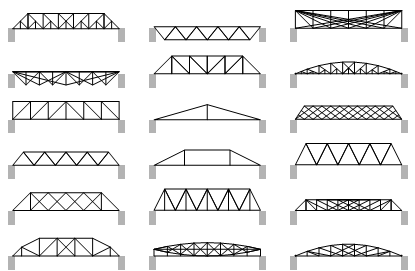
Bridges Over Troubled Waters

I was speaking with a couple of civil engineers tonight that specialised in bridge design. She told me that she had tried a number of her bridge designs to date, with each one lasting only a couple of years before they fell down. “That is how I learn to build a more effective one, you know, one that will last a life time.” The other engineer was a bit more coy about the bridges that he had built. But maintained that his bridges were not experimental.

I told them that I too was a bridge designer but had only designed one bridge to date and built a to-scale experimental option that lasted for 2 years.

“So you have only had one small scale, experimental bridge built and you call yourself a bridge designer?”
I told him that I considered his question rhetorical but he denied it, citing that he did not hear me tell him that I only had designed the one bridge in some 52 years. I asked him then if he could give me feedback on my record but he said it was not his place to make a comment.

Somehow I think that he considered that a real bridge designer will have designed and built a number of bridges and had them fail, to show a level of competence as an engineer. I prefer to think that a mark of a good bridge designer is someone that has studied hard, learning from actual bridge failures (from other engineers) and has tested a number of small scale options before they actually set out to build a full scale structure of their own. Having a design last one’s life time, to me is one of the marks of a good designer. None of us could claim that, so far.

After 12 years of trawling through the data from my trial and hopefully learning what were its strengths and weaknesses, I am hoping to test my first full scale structure soon.
I do consider my training has come to a point where I am confident my design could stand the test of time and life stresses.

Posted in Agreements | 1 Comment

My Speculation on Our Fear of Losing Bias

I think our bias is powered by our fear of losing our self (potential) and the fear of losing the other (existent) or is it our fears that that power our bias. Either way it drives us to seek feedback from others.

So maybe the more we understand our bias the more likely we will seek real conversation
(dissent, disagreement, etc) based on using agreed rules of engagement and in me & Steve’s case, the 6As.

How we go about seeking quality feedback will depend how we deal with our fears/bias. All designed to make better decisions so that we can predict the future (for today), maybe.

Reasonable Certainty might be certain about the moment and today only (through agreements). Reasonable Uncertainty might be focusing on our fears of losing for today. (aiming for agreements)

Unreasonable Certainty might be being certain about more than today.
Unreasonable Uncertainty might be focusing on our fears of losing about more than today.

But then again I might be just biased!

Posted in Agreements | Leave a comment