You’re Pissing Me Off

faac241ab4a4421ae1a9360465cf6f5eea2b015ed1fdc7366de247f3432243e4
To me the second most primitive way of approaching an argument or dispute is to
accuse the other person of starting to piss me off.
And the most primitive way, in my view, is to outright accuse the other person of now actually pissing me off.

And here is why:

  1. Because no-one-person is a problem for me, it is what they say and do.
  2. And because it is not even their behavior or what they say that “pisses me off”.
    The thing that is getting me angry is ME, in that I did not prepare and have agreed rules of engagement with this person before we had the conversation.

And the reason I think it is so primitive is, that if I get angry because of me and my lack of preparation, I can simply apologise for my anger,
ie  “I am sorry for getting angry as I could have prepared beforehand to avoid getting to this point.”
But if I am blaming the other person for making me angry, it seems to me, to be very difficult to apologise for “my anger” when I believe that you were actually responsible for it. In effect it is not my anger it is yours.
Posted in Agreements | Leave a comment

The Perfect Startup Team

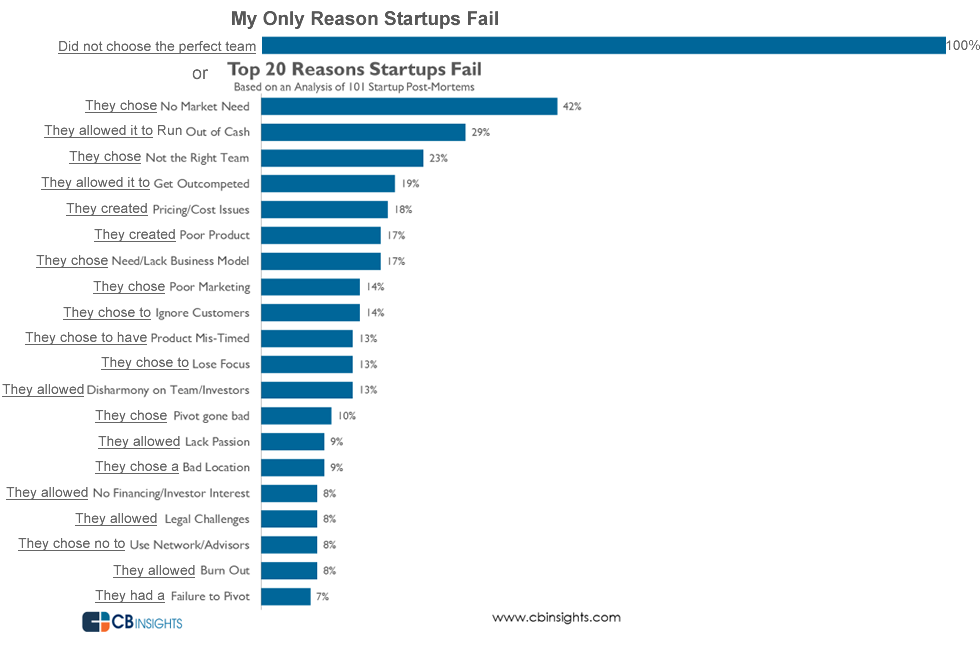
Imagine we were in the perfect startup team.

  • Then we would select the perfect market
  • And prepare so that we would not run out of cash
  • And we would have made sure we beat our competition
  • And got our pricing perfectly right
  • We would have created the perfect product
  • We would have the perfect business model
  • We would have the perfect marketing plan
  • We would perfectly recognise and attend to our customers
  • We would have gotten our timing perfectly right
  • And apply the perfect focus to boot
  • Maintain the perfect team harmony and select the perfect investors
  • Any pivot we made would be done perfectly
  • And we would have perfect passion (easy when everything is going perfectly)
  • We would have chosen the perfect location
  • And generated the perfect interest of the perfect investor
  • Have the perfect legal approach
  • With the perfect advisors
  • Choose the perfect work/life balance
  • They went to the perfect accelerator that gave them the street cred.

The perfect team can choose all the perfect directions and requirements that are needed to be the perfect startup. “But we are not perfect, nor is there a perfect team” I hear you say. Ok, fair enough, so the closer we are to the perfect team
or the less imperfect our team is the better we can achieve all of the mentioned
actions needed for a successful startup.

So, all we need to do is choose a really great team, but then again I guess we need to be a really great team member to do that, and to make sure we have a really great culture to keep that really great team together.

I don’t think that we need anything more than the ability to be part of a really great team and to be able to maintain that really great team for the period of that startup to be successful. And of course some degree of luck, to boot.

Untitled-2

Posted in Agreements | Leave a comment

Stand Up for Stepping Up

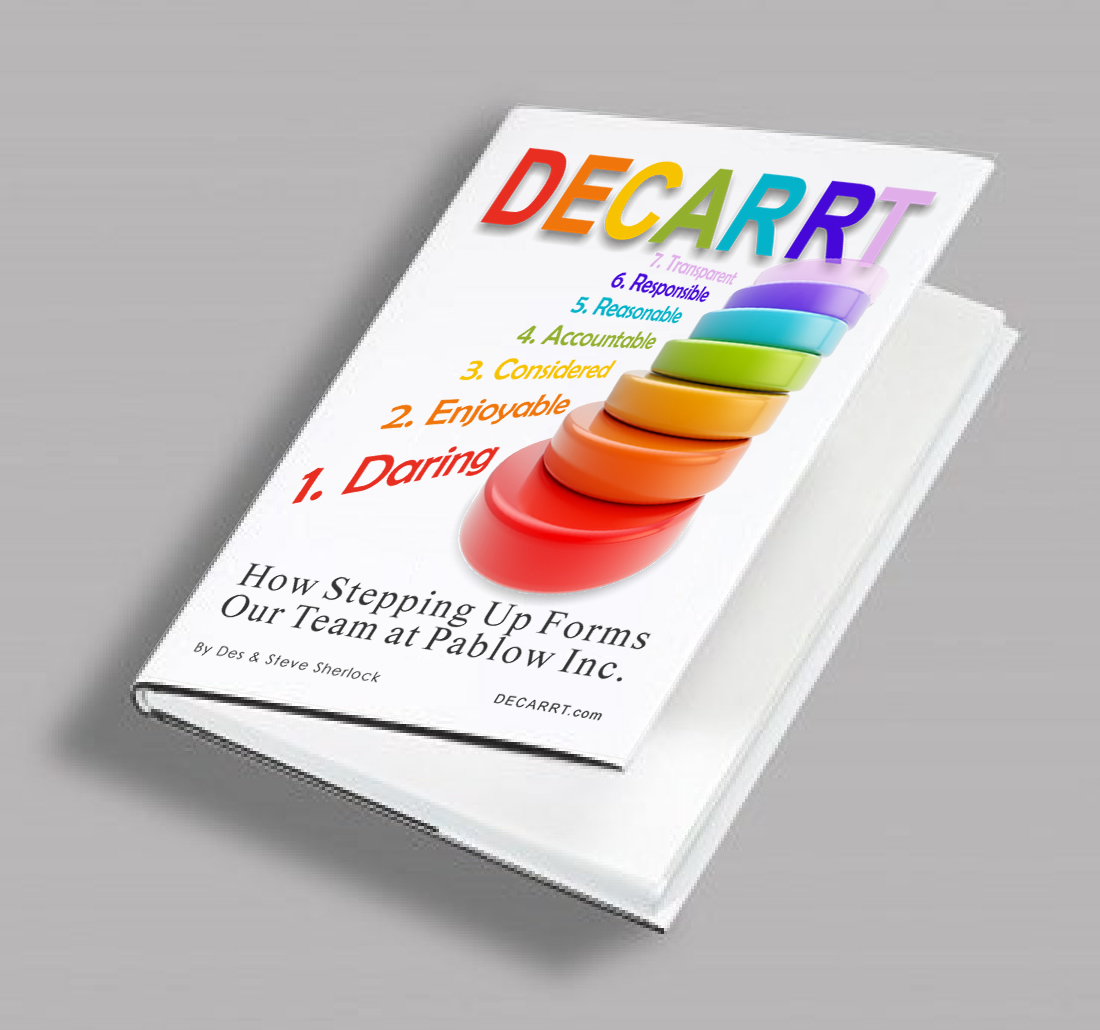
Possible book cover for my next book
Stand Up for Stepping Up, Seven steps to forming better agreements

See the Seven Steps in a bit more detail
Standing up book cover

Posted in Agreements | Leave a comment

Seven Steps to Stepping Up

After 25 years of working on our personal values we have come pretty close to putting them into some form of format or mission statement for our new business Pablow Inc. It is pretty simple really, where we believe that the most important thing we can do in a business or personal relationship is to take the initiative and step up when we feel it is necessary.

That is to speak up when we can see that something needs to be said. Stepping up “perfectly” is not an option, so it is more about learning to do it better and to improve our timing, taking a life time to master.

One person can step up and can be countered by another and sometimes it can get messy. So learning to step up in a Considered, Accountable, Reasonable, Responsible and Transparent way will go a long way to making it Enjoyable for all concerned and make it more constructive.
DECARRT is the Acronym for the 7 steps

Standing_up_book_cover3

  • Step 1. Daring is really the whole game, where we are taking a risk not knowing what the ultimate result will be but have faith that stepping up will always be for the better.
  • Step 2. Enjoyable using the things we have always found FUN such as creativity, idea generation and sketching to make sure that we enjoy ourselves when we try step up. With the rest of the steps designed to enhance our enjoyment.
  • Step 3. Considered means that we are cautious when we step up, using disclaimers, appreciation, acknowledging and apology when needed, especially when we are disagreeing with someone else.
  • Step 4. Accountable means that when we step up and it proves successful we get the accolade but if it fails then we get to give an acceptable apology. That we ensure that our approach is sustainable, adjustable and ultimately acceptable.
  • Step 5. Reasonable means bringing peace of mind through evidence based ideas with the ultimate goal of getting a resolution and results returning to stability even if it is fleeting, until the next step up.
  • Step 6. Responsible means being more formal and prepared in our approach to stepping up, but still allowing for bold, confident and audacious expressions. An example of stepping up responsibly is complaining responsibly, going direct to the person that you have an issue with and being prepared for the failure and to take a step back when necessary.
  • Step 7. Transparent means that we are all part of the experiment of stepping up and what we say and do is always open to scrutiny. After all the main reason that we step up is to leave open to question our own, individual, biases. It is only my view, In My View (IMV).
Posted in Agreements | 1 Comment

Converse Thinking v Convert Thinking

Whether it is during a conversation or while trying to get a conversion in sales, it seems to me that we to think in binary (right/wrong, win/lose, seller/buyer) or in over advocating our own idea, trying to convince and win someone over. ie Try to convert them.

But what if we were less converting in our thinking and more conversing? I think we can.

Consider v Convert
Where we simply try consider all the information more and try convert less. Get more info and dictate or use rhetoric less.

Converse v Convert
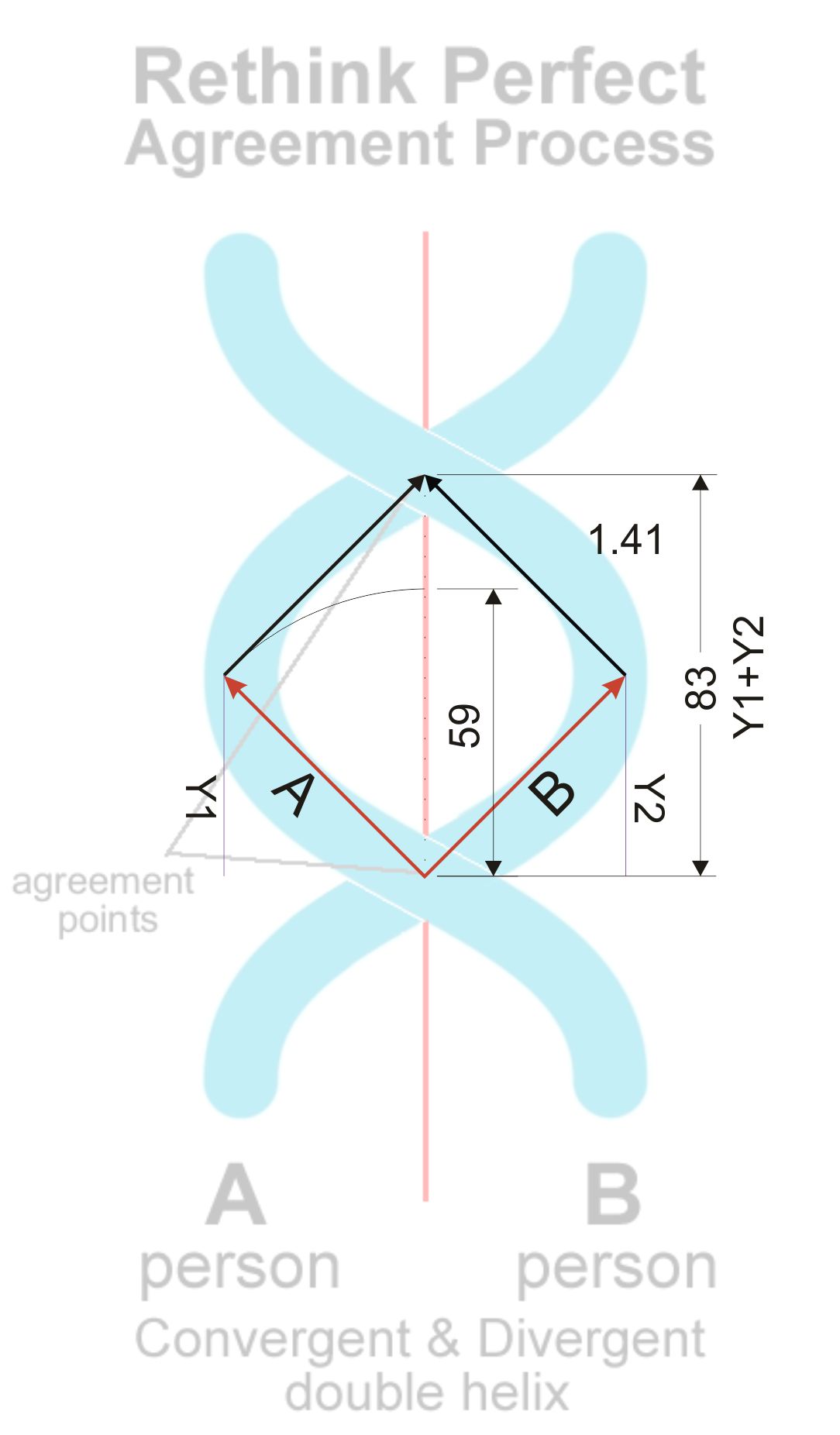
Where we cross over our thinking dynamically during conversation rather than an exchange of rigid and stifled monologues. Think of a double helix rather than a tug of war.

Context v Convert
Where we share how we think and why rather than staggered questions and answers, implying how and when the other should answer.

Converge v Convert
Where the goal is to both move to a position in between each other driven by reason rather than trying to pull the other over to our side and end up settling with compromise.

Conversion v Convert
Where we understand that the conversion occurs between both of us rather than one being the buyer and the other the seller.

Posted in Agreements | Leave a comment

Bathing in Biases

You know, it seems to me that we might not be quite aware of it, but we all could be bathing in our own and everyone else’s biases and not even realize it.

My guess is that we have this intricate process of decision making that is related to using our own biases and the biases of others so that we, somehow make decisions that take us to where we want to get to (some get there quicker and easier than others).

“What biases”, you may ask? Well just take a look on Wikipedia – Cognitive Biases and you might just get a surprise. There are about 200 listed and who knows how many we still do not know of or recognize?

So it seems that we were designed to be a social being and to share, through conversation, our own biases and balance them off with other peoples biases. If this is the case then what can we learn about the decision making process? It is complex!

In my view we need to decipher each other’s biases and make sure we understand who is trying to “sell” us what and why, before or while trying to process their information and ultimately make our “own” decision.

For example, say someone is telling us of the virtues of an oil extract, made from snakes. They say, that it helps our skin stay young looking, but they also happen to be selling bottles of them. The listener should be aware of that possibility and seek out this information. It is not up to the speaker to disclose, it is “buyer beware”, as they say.

I think that it is time that all of us, as listeners, smarten up, and take more responsibility for what we hear, one speaker at a time, in this ocean of biases.

Posted in Agreements, Bias, creative thinking, Relationships, Thinking | Leave a comment

Singular Intelligence

On my blog I have the quote by F Scott Fitzgerald  that: “The measure of a first rate intelligence is the ability to hold two opposing ideas and still function”. Well I think I have come up with a better measure for the 21st century: “The measure of singular intelligence is the ability to hold an infinite number of opposing ideas and still function”. I think I have worked out how to do that.
Ask me how?

Posted in Agreements | 2 Comments

We Think in Binary

Right – wrong, good – bad, hot – cold, up – down, far – near, responsible – irresponsible, love – hate, truth – lie, etc, etc.

I was telling my brother that we seem to think in “good” and “bad” and the first thing he told me was that I was wrong, ha!
(when he read this he reckoned I was lying! I replied that I did not agree that at least more was true.)

So understanding this can help us prepare for it. For example I reckon the definition of “wrong” is 75%(w) ± 25%(r) “right”, and “right” is 75%(r) ± 25%(w) “wrong”.

wrong=(w75% ± r25%)
right=(r75% ± w25%)

ie
wrong=w75% ± (r75% ± w25%)25%
right=r75% ± (w75% ± r25%)25%

This formula can expand adding the brackets for the w and r infinitely.
This leaves us with an ever decreasing wrong and an ever increasing right.

Think about that next time you use a binary word.

Posted in Agreements | Leave a comment

Long Circuit or Short Circuit Thinking

It seems to me that at times we can be so impatient that we will try find the short cut instead of going the full distance and end up with a short circuit.

I think most of our problems comes from short circuit thinking.
In the end timing is everything.

Posted in Agreements | Leave a comment

Double Helix Agreement Ratio

ratio2
A bit more on this double helix from a ratio that I prepared earlier.
Now call me crazy but it is nice to be able to use maths to explain agreements and there by disagreements.

Posted in Agreements | Leave a comment